Learn how to analyze mock test
data like a topper using score, accuracy, and time management strategies. This
detailed guide by Career Wave helps aspirants improve performance, reduce
mistakes, and boost exam scores effectively.
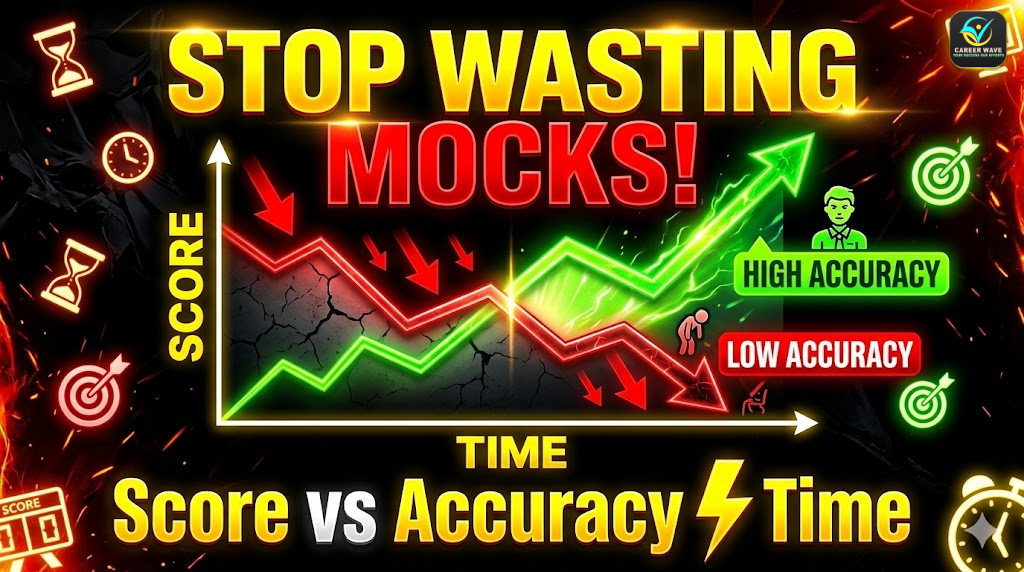
How to Use Mock Test Data Like a Topper (Score vs Accuracy vs Time
Analysis)
Most
aspirants give mock tests.
But very few actually use them properly.
At Career
Wave, we always emphasize one simple truth:
👉 “Your
rank doesn’t improve by giving more mocks — it improves by understanding your
data.”
If you start
reading your mock test like a report card of your thinking process, your
improvement becomes predictable, not random.
Let’s go deeper — much deeper —
into how toppers actually use mock test data.
Why Mock Test Data Is Your Real Teacher
Every mock
test gives you hidden insights:
·
How you
behave under pressure
·
Where you
lose marks unnecessarily
·
Which topics
are actually strong vs assumed strong
·
How your
brain makes decisions in limited time
Most
students ignore this.
Toppers
don’t.
They treat every mock as a performance
audit.
1. Advanced Score Analysis (Beyond Just
Numbers)
Most
students only see:
👉
“I scored 72 marks.”
Topper sees:
·
Section-wise
score
·
Score drop
reasons
·
Negative
marking impact
·
Attempt vs
score efficiency
🔍 Deep Questions to Ask:
·
Did I lose
marks due to wrong attempts or low attempts?
·
Which
section is unstable across mocks?
·
What is my minimum
guaranteed score?
👉
At Career Wave, we focus on score consistency, not just highest
score.
Because selection depends on stable
performance, not one lucky test.
2. Accuracy Analysis: The Backbone of
Selection
Accuracy is
not just a percentage — it is your decision quality indicator.
🔬 Break Accuracy into 3 Types:
1.
Conceptual
Errors
o You didn’t know the concept
o Needs revision
2.
Silly
Mistakes
o Calculation error
o Misreading question
o Overconfidence
3.
Risk-Based
Errors
o Guessing
o Over-attempting
👉
Most aspirants improve knowledge, but ignore decision errors.
That’s why
scores don’t improve.
🎯 Accuracy Benchmark Strategy:
·
Below 70% → High risk, reduce attempts
·
70–80% → Moderate control, improve clarity
·
80–90% → Strong zone (ideal)
·
90%+ → Safe but may need higher attempts
At Career Wave, students
are trained to maintain controlled aggression — not blind attempts.
3. Time Analysis: Micro-Level Optimization
Time is
where toppers gain an edge silently.
⏱️
Instead of total time, analyze:
·
Time per
question
·
Time per
section
·
Time wasted
on tough questions
🔍 Identify These Patterns:
·
Spending too
long on one question
·
Rushing easy
questions and making mistakes
·
Not leaving
time for revision
⚙️
The “Time Trap” Most Students Fall Into:
👉
They try to solve everything.
Topper
mindset:
·
Solve what
is worth solving
·
Skip what is
time-consuming
💡 Ideal Time Strategy:
·
First round
→ Easy + direct questions
·
Second round
→ Moderate
·
Third round
→ Risk-based attempts
This layered approach improves
both score and accuracy.
4. The Golden Formula: Score vs Accuracy vs
Time
📊
Understand the real relationship:
👉
Score = Attempts × Accuracy
(Because
there is no negative marking, wrong answers don’t reduce your score)
⚠️
But here’s the catch…
👉
Attempts depend on time management
👉 Accuracy
depends on concept clarity + decision quality
👉
So, increasing attempts alone doesn’t guarantee a higher score
5. Build Your Personal Data Dashboard (Like a
Topper)
At Career
Wave, we recommend maintaining a simple tracking sheet:
Track After
Every Mock:
·
Score
·
Accuracy %
·
Total
attempts
·
Correct vs
incorrect
·
Time spent
per section
·
Weak topics
·
Mistake type
📈 Weekly Review:
·
Is accuracy
improving?
·
Is score
stable or fluctuating?
·
Are mistakes
repeating?
👉
If mistakes repeat, your system is weak — not your effort.
6. The Power of Error Log (Most Ignored Tool)
Topper
secret: Error Notebook
Write:
·
Question you
got wrong
·
Why you got
it wrong
·
Correct
approach
·
What to
avoid next time
Revise this
weekly.
👉
This alone can increase your score by 15–25 marks over time.
7. Mock-to-Mock Improvement Strategy
Don’t give
mocks randomly.
Follow this
cycle:
1.
Attempt mock
seriously
2.
Analyze
deeply (1–2 hours)
3.
Fix mistakes
4.
Revise weak
areas
5.
Apply
changes in next mock
👉
Without this loop, mocks become useless.
8. Emotional Data: The Hidden Layer
This is
something most blogs don’t talk about.
After every
test, ask:
·
Did I panic
in any section?
·
Did one
tough question disturb my flow?
·
Did I lose
confidence mid-exam?
Because:
👉
Your emotions directly affect your accuracy.
At Career Wave, we train
students to build emotional stability along with academic strength.
9. Signs You’re Using Mock Data Like a Topper
✔ Your score
is becoming consistent
✔ Accuracy is improving gradually
✔ You know your safe attempt range
✔ You panic less during tough
sections
✔ Your mistakes are reducing, not
repeating
If this is happening — you’re on
the right track.
10. Why Most Students Fail Despite Giving
Many Mocks
Because
they:
·
Don’t
analyze deeply
·
Ignore
patterns
·
Repeat same
mistakes
·
Focus only
on score
·
Don’t change
strategy
👉
Giving 50 mocks without analysis = Giving 5 mocks effectively
How Career Wave Helps You Do This Better
At Career
Wave, test series is not just about questions.
It’s about:
·
📊
Data-driven performance tracking
·
📉
Accuracy improvement systems
·
⏱️ Time
management training
·
📘
Structured error analysis
·
🎯
Personalized strategy building
Because cracking exams is not
about studying more —
it’s about optimizing performance scientifically.
Final Thought
Mock test
data is like a map.
If you read
it properly, it shows:
·
Where you
are
·
Where you’re
going wrong
·
How to reach
selection
👉
Stop chasing marks.
👉 Start
understanding patterns.
That’s how toppers think.
That’s how selections happen.
FAQs
1. How much
time should I spend on mock test analysis?
Ideally 1.5–2 times the test
duration. Deep analysis gives maximum improvement.
2. What is
more important: attempts or accuracy?
Accuracy is more important.
Balanced attempts with high accuracy give the best score.
3. How can I
reduce negative marking?
Avoid guesswork, use elimination
techniques, and attempt only when reasonably confident.
4. Should I
re-attempt the same mock test?
Not immediately. First analyze
mistakes, then revisit after a few days for reinforcement.
5. Can mock
test analysis alone improve my score?
Yes, significantly. Many students
improve 20–30 marks just by fixing mistakes and optimizing strategy.
Related Blogs -
How to Build Exam Temperament (Advanced Guide by Career Wave)
How Many Mock Tests Should You Attempt Before the ATC Exam?
Full-Length Mock Tests vs Sectional Tests – Which Is Better for ATC Preparation?
Leave a Comment
21-Jul-2026 02:43 PM
Learn why most students quit AAI ATC preparation and how to stay consistent with the right study plan, Physics-Maths strategy, mock analysis, revision cycle, and...
20-Jul-2026 12:29 PM
Learn how to complete the AAI ATC syllabus without burnout using a realistic study plan, smart revision cycle, PYQ practice, mock test analysis, short notes,...
18-Jul-2026 03:53 PM
Learn what to expect from night shifts in AAI ATC, including duty routine, challenges, sleep management, alertness, work-life balance, and professional guidance from Career Wave...
17-Jul-2026 03:47 PM
Learn why your AAI ATC mock score is not improving and how to fix it with proper mock analysis, mistake notebook, formula revision, PYQ practice,...
16-Jul-2026 04:48 PM
Learn how to improve accuracy in the AAI ATC exam with concept clarity, formula revision, PYQ practice, mock test analysis, mistake notebook strategy, and guidance...
15-Jul-2026 04:25 PM
Learn what to do in the last week before the AAI ATC exam with smart revision, mock test strategy, formula recall, mistake notebook practice, and...
