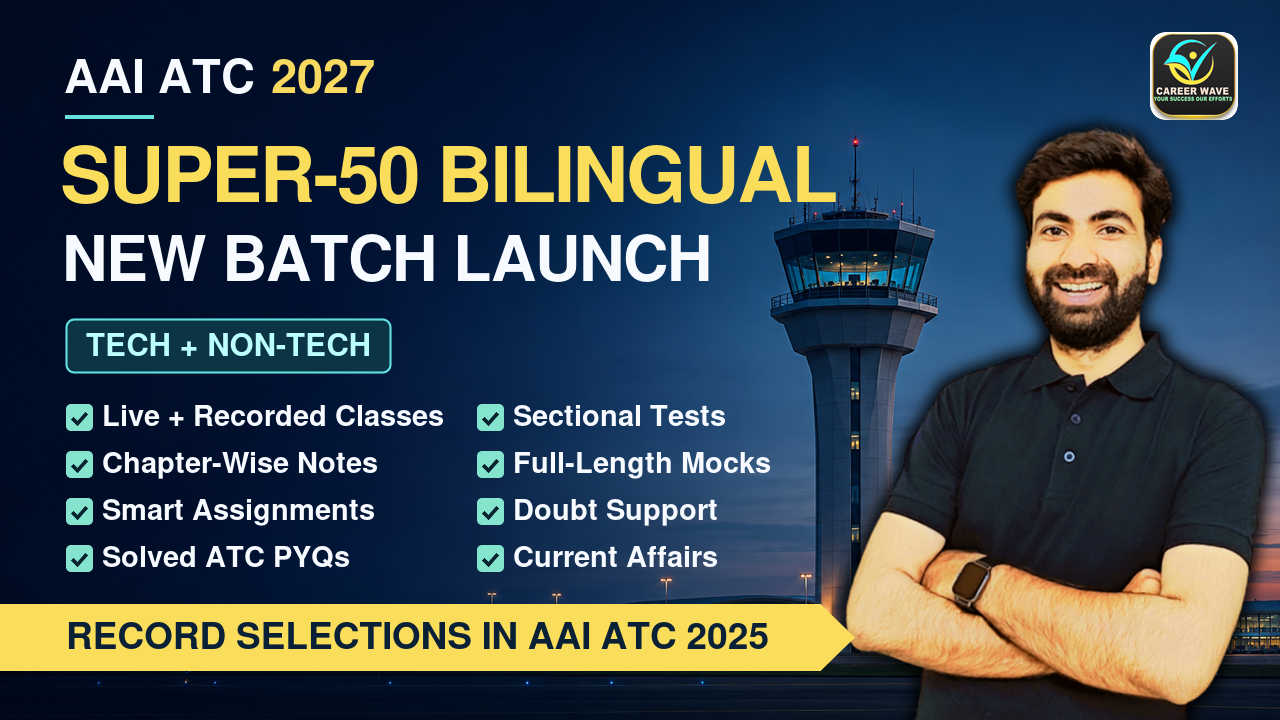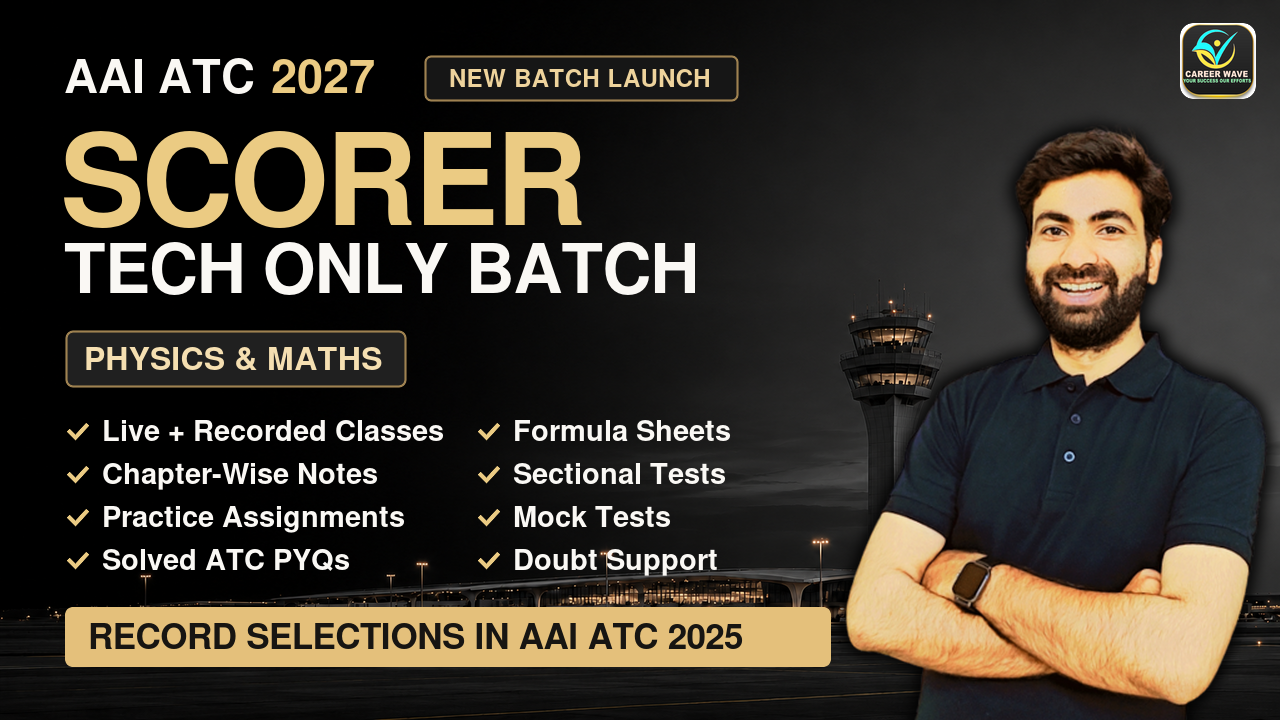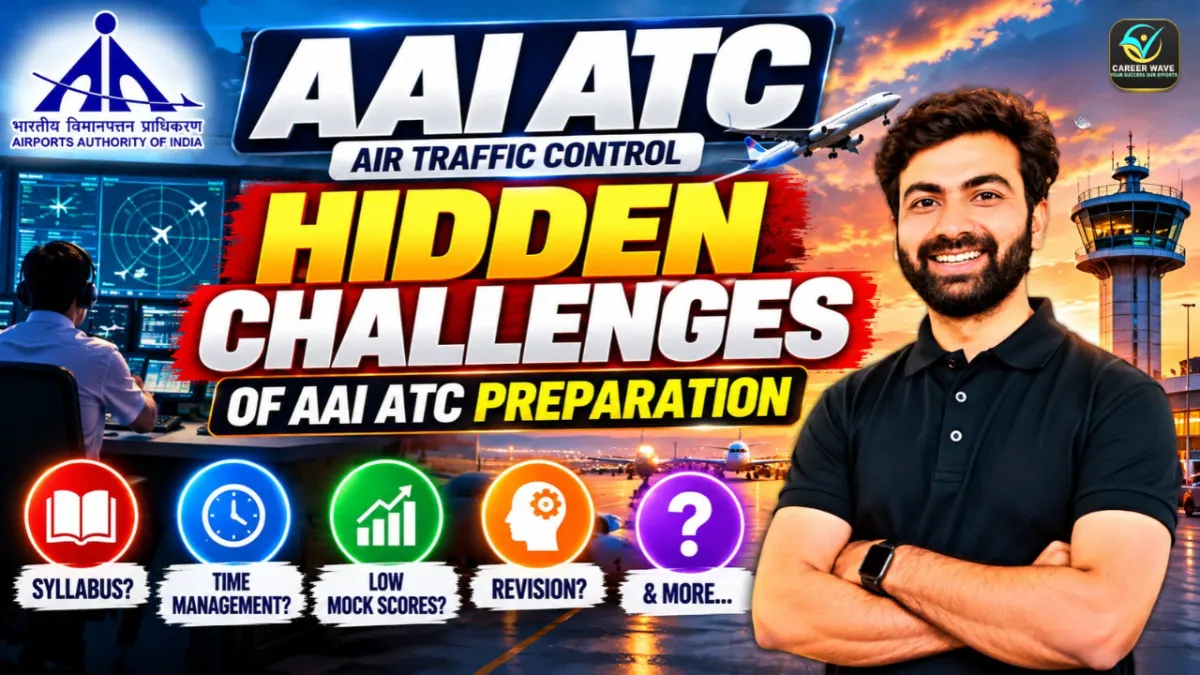
Preparing for AAI ATC 2026 but
struggling with low mock scores, forgotten formulas, incomplete revision, or
time management? Discover the 25 hidden challenges of AAI ATC preparation with
Career Wave and Satyendra Sir. Learn how to balance Physics, Mathematics,
English, Reasoning, Aptitude, and General Awareness. Explore practical
solutions for syllabus completion, PYQ practice, mock test accuracy, study
consistency, exam pressure, and final revision. Build a smart, structured
preparation strategy to improve your confidence and exam performance.
AAI ATC 2026 Preparation Strategy | Common Hidden Problems, Study Mistakes, Mock Test Challenges, Revision Tips & Expert Guidance by Satyendra Sir
Preparing for the AAI Junior Executive (Air Traffic Control) examination is not just about completing Physics, Mathematics, English, Reasoning, Aptitude, and General Awareness.
There are several challenges that students experience during preparation but rarely discuss openly.
You may study for six to eight hours daily and still feel that your preparation is incomplete. You may understand a Physics concept during class but struggle to solve a similar question independently. You may perform well in sectional tests but lose marks in full-length mock tests.
Sometimes, the biggest challenge is not the syllabus itself. It is managing revision, maintaining consistency, identifying weaknesses, and converting knowledge into marks.
At Career Wave, Satyendra Sir emphasizes that students must understand these hidden preparation challenges before they begin affecting their examination performance.
In this article, we will discuss the 25 hidden challenges of AAI ATC preparation, their impact on aspirants, and practical solutions to overcome them.
One of the most common problems in AAI ATC preparation is giving excessive attention to Physics and Mathematics.
Both subjects are important, but they do not represent the entire examination.
The recent AAI ATC CBT pattern has followed this distribution:
|
Subject |
Questions |
Marks |
|
Physics |
30 |
30 |
|
Mathematics |
30 |
30 |
|
English Language |
20 |
20 |
|
Reasoning |
15 |
15 |
|
General Aptitude |
15 |
15 |
|
General Awareness |
10 |
10 |
|
Total |
120 |
120 |
The table reflects the recent examination pattern. Candidates should verify the latest official recruitment notification for the applicable syllabus and marking scheme.
Physics and Mathematics contribute 60 marks, while non-technical subjects contribute another 60 marks.
Students spend most of their time solving Physics and Mathematics questions while postponing English, Reasoning, Aptitude, and General Awareness.
Prepare both sections simultaneously.
Allocate regular time to non-technical subjects instead of leaving them for the final month.
Satyendra Sir's Advice: AAI ATC preparation should be balanced. Strong technical knowledge cannot fully compensate for neglected non-technical subjects.
Many students believe that finishing all lectures means their preparation is complete.
But watching a lecture and solving an examination-level question are different skills.
A student understands the derivation of a Physics formula but cannot identify the correct formula when the question is presented differently.
Similarly, a student completes a Mathematics chapter but struggles with unfamiliar question patterns.
After completing every chapter:
1. Revise the important concepts.
2. Solve standard questions independently.
3. Practise chapter-wise PYQs.
4. Attempt moderate and difficult questions.
5. Take a short chapter test.
6. Analyse incorrect answers.
Important: Measure chapter completion through understanding and problem-solving ability, not just lecture completion.
Watching educational videos can feel productive.
However, passive learning may create a false sense of understanding.
Students watch several lectures continuously without solving questions.
When they attempt a test, they realize that they cannot apply the concepts independently.
Use an active learning approach.
After studying a concept, solve relevant questions without looking at the solution.
If you cannot solve them, revisit the concept before moving forward.
Physics involves many formulas, conditions, and applications.
Aspirants often remember formulas immediately after studying a chapter but forget them several weeks later.
Students complete Electrostatics, Current Electricity, Magnetism, and Modern Physics but struggle to recall earlier formulas during revision.
Maintain a dedicated Physics formula notebook.
Include:
Revise the notebook regularly and apply the formulas through questions.
Career Wave Tip: Formula revision becomes more effective when combined with numerical practice.
This is another hidden challenge.
Students may remember integration formulas, trigonometric identities, and probability rules but struggle to select the correct method.
The difficulty is not always remembering the formula.
Sometimes, it is identifying the mathematical approach.
For each Mathematics chapter, practise different question types.
Understand:
Do not depend entirely on memorized shortcuts.
Some aspirants believe that solving the hardest questions is the best way to prepare.
Difficult questions can improve conceptual understanding, but excessive time spent on them may reduce overall syllabus coverage.
A student spends 40 minutes on one complicated numerical while ignoring several important chapters.
Divide questions into three levels:
Level 1: Basic conceptual questions.
Level 2: Standard exam-level questions.
Level 3: Advanced or time-consuming questions.
Prioritize exam-relevant questions and strengthen fundamentals before attempting unusually difficult problems.
English is often underestimated.
Students assume that basic communication skills are enough to score well.
During mock tests, students lose marks in grammar, vocabulary, sentence improvement, and comprehension.
Practise English regularly.
Focus on:
Maintain a notebook for frequently confused grammar rules and vocabulary.
Reasoning and Aptitude may appear easier than technical subjects.
However, they require practice and time management.
Students know the basic concepts but take too long to solve questions.
Practise short, timed sets regularly.
For Reasoning, focus on pattern recognition and logical accuracy.
For Aptitude, improve calculation speed and learn reliable solving methods.
Important Aptitude topics include:
General Awareness is frequently postponed because its syllabus appears broad.
Students leave History, Geography, Polity, Economy, General Science, and Current Affairs for the final weeks.
This creates unnecessary pressure.
Study General Awareness in small daily sessions.
Prepare concise notes and revise them regularly.
For current affairs, prioritize reliable and updated sources.
Avoid collecting excessive material that cannot be revised effectively.
Many students collect multiple books, PDFs, video playlists, and practice sets.
Instead of completing one resource properly, they repeatedly switch between different materials.
This creates confusion and unfinished work.
Use a limited resource system:
Satyendra Sir's Advice: More resources do not automatically mean better preparation. The value lies in how effectively you use them.
Previous year questions are among the most useful preparation resources.
But students often use them incorrectly.
Some aspirants memorize PYQ answers without understanding the underlying concepts.
When a similar concept appears in a different format, they struggle.
After solving a PYQ, ask:
For numerical questions, practise variations with different values.
A student may study for eight hours but complete very little meaningful practice.
Another student may study for five focused hours and make measurable progress.
Students judge preparation by the number of hours spent studying.
Track meaningful outcomes:
|
Activity |
Progress Indicator |
|
Physics |
Concepts understood and questions solved |
|
Mathematics |
Accuracy and problem-solving speed |
|
English |
Grammar and vocabulary improvement |
|
Reasoning |
Correct answers under time limits |
|
Aptitude |
Calculation accuracy |
|
General Awareness |
Facts retained after revision |
|
Mock Tests |
Score, accuracy, and mistake reduction |
Measure progress through learning and performance, not just time spent.
Revision is one of the biggest hidden challenges in AAI ATC preparation.
Students keep studying new chapters while forgetting older ones.
When the syllabus is complete, they realize that much of the material needs to be studied again.
Use a structured revision cycle.
Daily: Revise recently studied concepts.
Weekly: Revise completed chapters and formulas.
Monthly: Review older topics and weak areas.
Before Mocks: Revise recurring mistakes.
After Mocks: Revisit concepts that caused incorrect answers.
The revision frequency should depend on how well you retain each topic.
Many students attempt mock tests regularly but do not improve significantly.
They check the total score, review a few answers, and immediately attempt another mock.
After every mock, identify:
Then revise the relevant concepts before attempting similar questions again.
For structured mock-test practice
Satyendra Sir's Advice: Mock-test analysis is just as important as attempting the test itself.
Some students perform well in individual subject tests but struggle in full-length mocks.
Sectional tests require concentration on one subject.
Full mocks require students to switch between different subjects, manage time, and maintain accuracy throughout the examination.
Gradually increase practice difficulty.
Start with chapter-wise tests, move to sectional tests, and then attempt full-length mocks.
Practise changing between subjects without losing concentration.
Knowing the answers is not enough if students cannot complete the paper efficiently.
Aspirants spend too much time on difficult numerical questions and leave easier questions for the end.
Use a two-round approach.
Round 1: Attempt familiar and relatively quick questions.
Round 2: Return to questions requiring more calculations or reasoning.
Experiment with different section orders during mocks.
Choose the approach that consistently produces better performance.
This is a major reason some students experience stagnant scores.
Students repeatedly make the same formula, calculation, grammar, or reasoning mistakes.
|
Subject |
Mistakes to Record |
|
Physics |
Formula, units, concepts, sign errors |
|
Mathematics |
Calculation and method errors |
|
English |
Grammar and vocabulary confusion |
|
Reasoning |
Logical and pattern-recognition errors |
|
Aptitude |
Percentage, ratio, calculation, and shortcut errors |
|
General Awareness |
Incorrect facts and outdated information |
Revise recurring errors before important mock tests.
Mock-test comparisons can create unnecessary pressure.
A student scoring 75 marks sees another aspirant scoring 105 and begins doubting the entire preparation strategy.
Compare your current performance with your previous performance.
Track:
Other students' scores may provide a reference, but they should not determine your confidence.
AAI ATC aspirants frequently discuss expected cutoffs.
While previous cutoffs can provide context, they cannot guarantee the cutoff for a future recruitment cycle.
Students become excessively focused on predicted cutoffs instead of improving their preparation.
Use previous cutoffs only as reference information.
Set an ambitious but realistic score target and focus on maximizing marks.
Avoid relying on unofficial cutoff predictions as though they are confirmed results.
AAI ATC preparation may require sustained effort over several months.
Students begin with enthusiasm but gradually become inconsistent.
They miss revision sessions, postpone practice tests, and accumulate unfinished chapters.
Create a sustainable timetable.
Include:
A timetable that can be followed consistently is more useful than an unrealistic schedule.
Many AAI ATC aspirants are college students or working professionals.
Limited time makes it difficult to attend lectures, solve questions, revise, and attempt mocks.
Prioritize activities according to their impact.
For example:
Weekdays: Concept learning, focused practice, and short revision.
Weekends: Longer practice sessions, mock tests, and performance analysis.
Use flexible resources where necessary.
Avoid creating a schedule that ignores academic, professional, or personal responsibilities.
A low mock score can be discouraging, especially when the examination is approaching.
Students interpret one poor performance as proof that their preparation is inadequate.
Treat mock scores as diagnostic information.
After a low score:
1. Identify the main reasons.
2. Separate conceptual mistakes from careless errors.
3. Revise the relevant topics.
4. Practise similar questions.
5. Attempt another test after targeted improvement.
One mock score does not define your final examination performance.
Some aspirants focus entirely on the written examination.
However, the recruitment process can include additional assessments and verification requirements.
Depending on the applicable official notification, these may include:
Students may learn about these requirements only after the CBT.
Read the complete official recruitment notification before applying.
Understand the eligibility conditions, selection stages, and applicable medical standards.
Prepare for communication-related assessments where required.
Students often watch multiple strategy videos and repeatedly change their study plans.
They spend more time planning than studying.
A new timetable is created every week, but no timetable is followed consistently.
Select a realistic plan and evaluate it through weekly performance.
Modify the plan only when necessary.
For example, increase Mathematics practice if accuracy remains low or allocate additional time to General Awareness if revision is insufficient.
Satyendra Sir's Advice: Preparation strategies should be adjusted using actual performance data, not every new opinion you encounter.
The final weeks before the examination are particularly important.
Students attempt to learn too many new concepts while neglecting revision and mock-test analysis.
Create a focused final revision plan.
Prioritize:
Avoid unnecessary new resources during the final days.
To overcome these hidden challenges, students need a balanced weekly routine.
|
Day |
Main Focus |
Additional Practice |
|
Monday |
Physics + Mathematics |
English |
|
Tuesday |
Physics + Aptitude |
Reasoning |
|
Wednesday |
Mathematics + Physics |
General Awareness |
|
Thursday |
Mathematics + Reasoning |
English |
|
Friday |
Physics + Mathematics |
Aptitude |
|
Saturday |
Technical Revision |
Sectional Tests |
|
Sunday |
Full Mock Test |
Detailed Analysis |
This is an illustrative timetable. Students should modify it according to their syllabus coverage, weak subjects, and available study hours.
At Career Wave, Satyendra Sir focuses on helping aspirants approach the AAI ATC examination with conceptual clarity, disciplined preparation, and exam-oriented practice.
Students can strengthen their preparation through subject guidance, previous year questions, revision resources, and mock tests.
Understand Physics and Mathematics concepts before attempting complex questions.
Use PYQs to identify important concepts and understand previous examination trends.
Attempt mocks to evaluate preparation, improve time management, and identify weak areas.
Follow Career Wave's educational content for subject preparation, revision strategies, and examination guidance.
Career Wave YouTube Channel:
The biggest mistake in competitive examination preparation is assuming that studying more automatically means preparing better.
Students need to understand what is preventing their scores from improving.
Sometimes the problem is weak concepts.
Sometimes it is insufficient revision.
Sometimes it is poor time management or repeated mistakes.
And sometimes students have completed the syllabus but have not practised enough questions independently.
The solution is to identify the actual problem and correct it systematically.
Satyendra Sir recommends following this preparation cycle:
Learn Concepts → Practise Questions → Solve PYQs → Attempt Tests → Analyse Mistakes → Revise → Improve
At Career Wave, the focus is on helping students make preparation more organized, measurable, and examination-oriented.
AAI ATC preparation is not difficult only because of the syllabus.
The real challenges often involve managing time, maintaining consistency, remembering formulas, balancing subjects, analysing mock tests, and avoiding repeated mistakes.
Students who recognize these problems early can take practical steps to improve their preparation.
Instead of studying randomly, follow a structured plan.
Instead of collecting more resources, complete and revise reliable material.
Instead of worrying about every mock score, analyse the mistakes behind it.
And instead of comparing yourself constantly with others, focus on measurable improvement.
At Career Wave, Satyendra Sir encourages aspirants to build a preparation system based on conceptual clarity, regular practice, and continuous improvement.
Remember: Completing the syllabus is one milestone. Developing the ability to perform accurately under examination conditions is the real objective.
Stay connected with Career Wave and Satyendra Sir for AAI ATC 2026 preparation strategies, Physics and Mathematics guidance, PYQs, mock tests, and examination updates.
Career Wave — Your Success, Our Efforts
 What Can We Learn from Career Wave's Selected AAI ATC Students? Success Stories...
23 Nov 2026
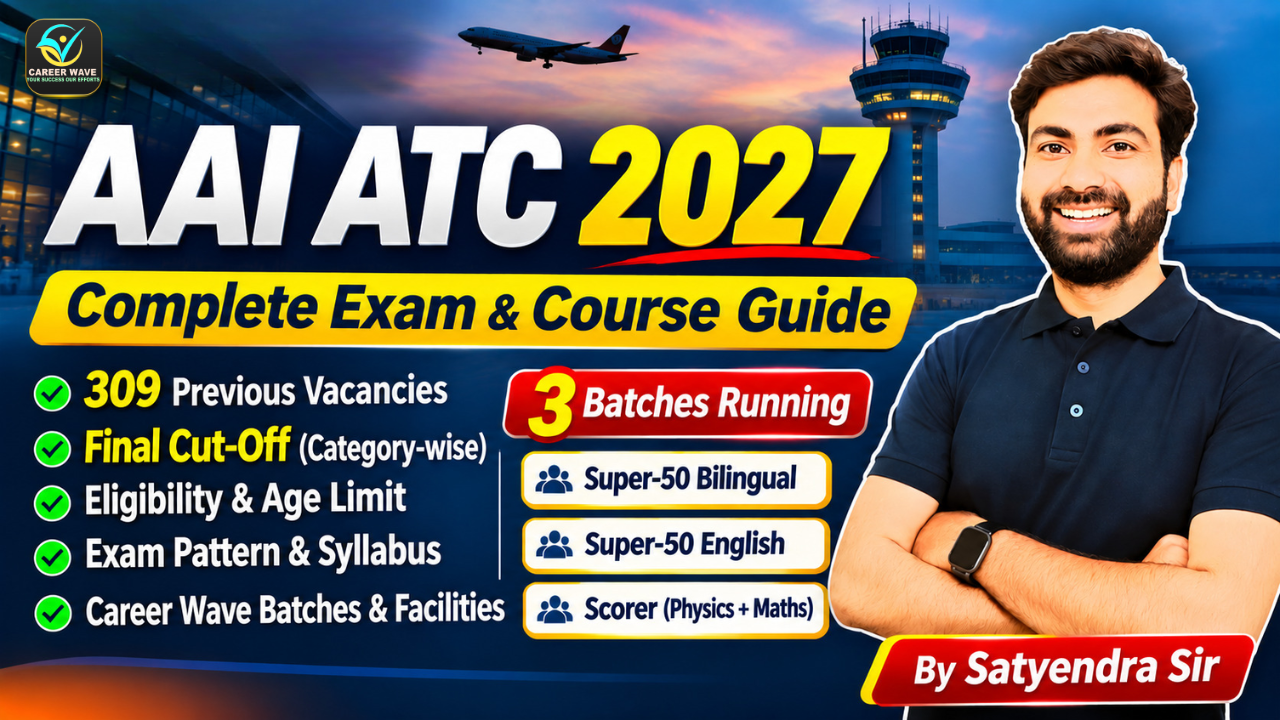 AAI ATC 2027: Notification, Eligibility, Syllabus, Exam Pattern, Salary, Cut-Off...
23 Nov 2026
 RRB Group D Score Card 2026 and ALP CBT-1 Answer Key: Score, Cut-off and Next St...
22 Nov 2026
 AAI JE AO 2026 Answer Key: Status, Score Calculation, Paper Analysis and Expecte...
22 Nov 2026
 SSC JE 2026 IMD Scientific Assistant Answer Key: Score Calculation, Objections a...
22 Nov 2026
 B.Sc vs B.Tech for AAI ATC 2027: Best Preparation Strategy for Each
19 Nov 2026
Leave a Comment
23-Nov-2026 02:05 PM
What Career Wave's selected AAI ATC students did differently: real testimonials, PYQ and mock-test methods, a 6-month plan and mistakes to avoid in 2027.
23-Nov-2026 01:23 PM
AAI ATC 2027 guide: notification status, eligibility, age limit, exam pattern, syllabus, salary, 2025 cut-offs and Career Wave’s 3 live batches compared.
22-Nov-2026 03:58 PM
RRB Group D score card is out till 1 Dec and ALP CBT-1 objections are closed. Check your score, qualifying marks, PET standards and next...
22-Nov-2026 11:51 AM
AAI JE Operations 2026 answer key status, how to calculate your score out of 120, the 26 Oct paper analysis and the expected cut-off of...
22-Nov-2026 11:23 AM
SSC JE 2026 Paper-I answer key for IMD Scientific Assistant is out. Learn how to calculate your score, raise objections before 22 Nov 6 PM...
19-Nov-2026 03:50 PM
B.Sc vs B.Tech: Who has an advantage in AAI ATC 2027? Discover the right preparation strategy for B.Sc Physics, B.Sc Mathematics and Engineering graduates. Compare...
 Career WaveOn WhatsApp
36,000+ learners · 4.8★ on Google