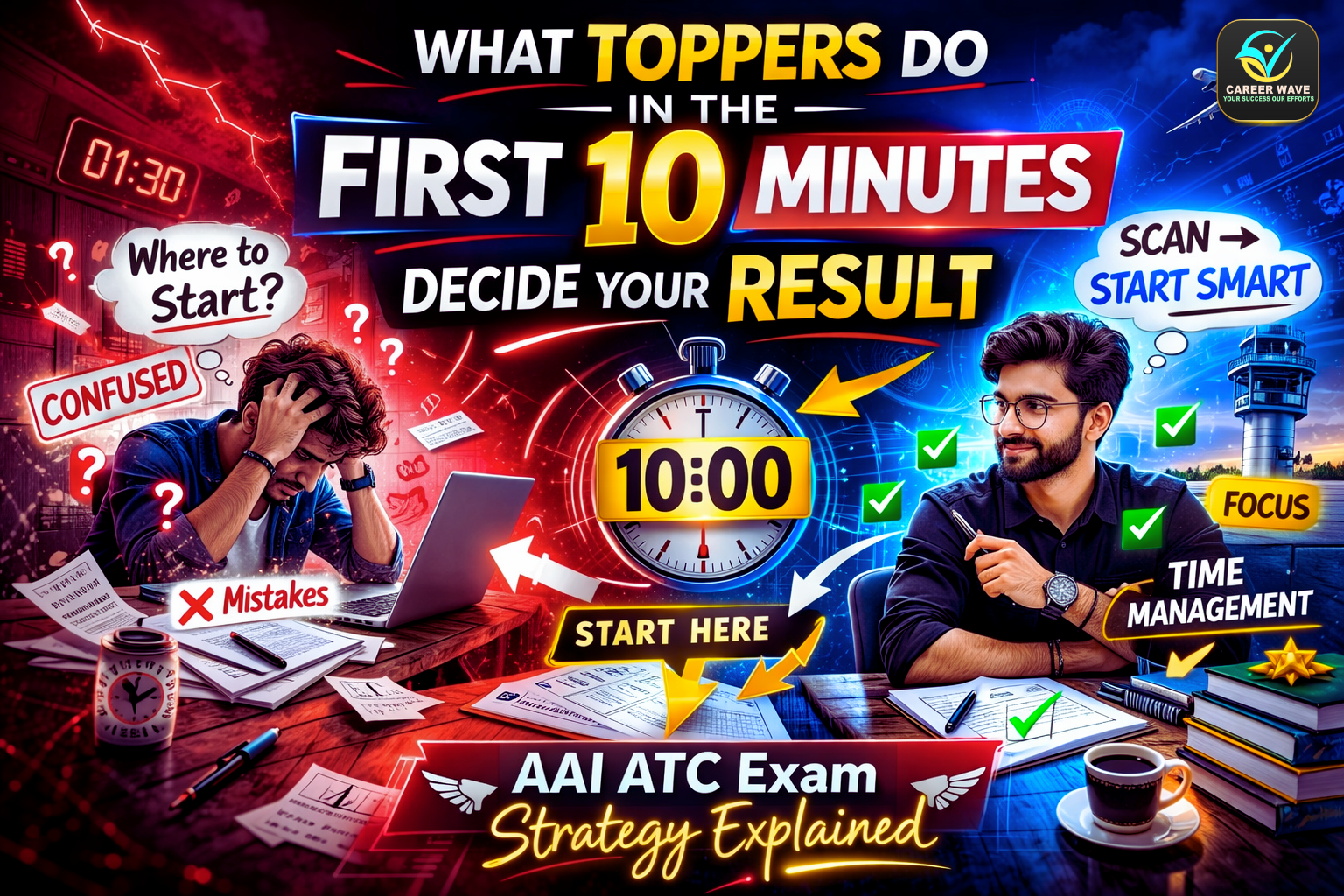
Discover the proven strategies
toppers use in the first 10 minutes of the AAI ATC exam. Learn how scanning,
smart question selection, accuracy focus, and momentum-building techniques can
dramatically improve your final score.
What Toppers Do Differently in the First 10 Minutes
In competitive exams like AAI ATC
(Junior Executive – Air Traffic Control), the first 10 minutes can silently
decide the final result.
Most aspirants think success depends on how much they studied.
Toppers know success depends on how they start the exam.
Those first 10 minutes are not just about solving questions — they are about
setting rhythm, managing pressure, and building momentum.
Let’s break down what toppers do differently in the first 10 minutes of the
exam.
1) They Don’t Panic — They Scan
Average
candidates start solving immediately.
Toppers
don’t.
They spend
the first 1–2 minutes scanning:
·
Section
order
·
Question
distribution
·
Difficulty
level
·
Lengthy
calculations
This quick
mental mapping helps them decide:
·
Where to
start
·
What to skip
initially
·
Which
section can build early confidence
They enter the exam with a plan —
not emotion.
2) They Start with High-Accuracy Questions
Toppers do
not begin with the hardest question.
They start
with:
·
Direct
concept-based questions
·
Familiar
patterns
·
Short
calculation problems
Why?
Because
early accuracy builds:
·
Confidence
·
Speed rhythm
·
Mental
stability
The goal of the first 10 minutes
is not maximum attempts.
It is maximum stability.
3) They Avoid Time Traps
Many
aspirants lose 5–7 minutes on one tricky question.
Toppers
follow a strict internal rule:
If a question doesn’t click within 30–40 seconds, mark and move.
They
understand:
The exam rewards total score — not ego battles.
Letting go early protects
momentum.
4) They Control Breathing and Body Language
This sounds
simple but is powerful.
Toppers:
·
Sit straight
·
Breathe
steadily
·
Avoid
rushing clicks
·
Keep calm
facial expressions
Why?
Because physical calmness
supports mental clarity.
The first 10 minutes set emotional tone for the entire paper.
5) They Focus on Accuracy Over Speed
In the first
10 minutes, toppers:
·
Read
carefully
·
Avoid silly
mistakes
·
Double-check
options
They know:
A wrong answer early creates self-doubt.
Accuracy creates confidence.
Confidence increases speed automatically.
6) They Follow a Pre-Decided Strategy
Toppers do
not experiment on exam day.
Before the
exam, they already know:
·
Which
section to start with
·
Target
attempts per section
·
Ideal time
distribution
The first 10
minutes are execution time — not decision time.
This clarity removes hesitation.
7) They Ignore Other Candidates
Some
aspirants get distracted by:
·
Fast mouse
clicks
·
Page
switching sounds
·
Others
submitting early
Toppers stay
internally focused.
They compete with their
preparation — not the room.
8) They Build Early Momentum
Momentum is
everything.
In the first
10 minutes, toppers aim to:
·
Solve 5–8
clean questions
·
Build
confidence
·
Lock early
marks
This creates
psychological advantage.
Once momentum builds, performance
improves naturally.
The Hidden Truth About the First 10 Minutes
The first 10
minutes are not about intelligence.
They are about control.
Control of:
·
Time
·
Emotions
·
Question
selection
·
Strategy
execution
Toppers don’t just know more.
They manage the exam better.
How You Can Apply This
Before your
next mock test:
1.
Decide your
starting section.
2.
Set a
10-minute performance goal.
3.
Practice
scanning before solving.
4.
Train
yourself to skip quickly.
5.
Review your
first 10-minute performance after every mock.
If you master the first 10
minutes, you control the exam — not the other way around.
Final Thought
Exams are
won in moments, not hours.
The first 10
minutes define:
·
Your
confidence
·
Your pace
·
Your score
trajectory
Average
candidates react to the paper.
Toppers take control of it.
Start strong. Stay controlled.
Finish powerful. ✈️
Frequently Asked Questions (FAQs)
Q1. Why are
the first 10 minutes so important in competitive exams like AAI ATC?
The first 10
minutes set the tone for the entire exam. They determine your confidence,
rhythm, and time management. A calm and strategic start helps avoid panic,
reduces silly mistakes, and builds early momentum that carries forward
throughout the paper.
Q2. Should I
start solving immediately when the exam begins?
Not
necessarily. Toppers usually spend the first 1–2 minutes scanning the paper to
understand question distribution and difficulty level. This quick analysis
helps them decide the best section to start with instead of reacting
impulsively.
Q3. How many
questions should I aim to solve in the first 10 minutes?
There is no
fixed number, but the goal should be high-accuracy attempts, not maximum
attempts. Ideally, focus on solving easy and familiar questions cleanly to
build confidence and stability early in the exam.
Q4. What if
I get stuck on a question in the beginning?
If a
question does not click within 30–40 seconds, it’s better to mark it for review
and move ahead. Spending too much time early can break momentum and increase stress.
Q5. Is speed
more important than accuracy in the first 10 minutes?
No. Accuracy is more important in
the initial phase. Early mistakes can create self-doubt. Once accuracy builds
confidence, speed improves naturally.
Related blog-
The Psychological Cost of One Wrong Guess in AAI ATC
AAI ATC Success Patterns Observed in Career Wave Toppers
Why Career Wave Focuses More on Decision-Training Than Syllabus
Leave a Comment
09-Sep-2026 12:05 PM
Learn the best AAI AO Full Mock Test Strategy 2026 to manage exam time effectively. Career Wave and Satyendra Sir explain section order, two-round attempt...
08-Sep-2026 02:40 PM
Learn how to improve accuracy in AAI JE Airport Operations 2026 mock tests and reduce silly mistakes. Career Wave and Satyendra Sir explain practical strategies...
08-Sep-2026 10:51 AM
Discover why mock tests are essential for AAI JE Airport Operations 2026 preparation. Learn how Full Mock Tests and Sectional Tests help improve speed, accuracy,...
07-Sep-2026 03:52 PM
Prepare for AAI JE Airport Operations 2026 with Career Wave’s exam-focused Test Series. Get Full-Length Mock Tests, Sectional Tests, latest pattern-based questions, detailed solutions, performance...
07-Sep-2026 11:27 AM
Check the complete IMD Scientific Assistant Physics Syllabus 2026 for Part-F as per the official SSC JE 2026 notification. Get chapter-wise topics including Mathematical Methods,...
05-Sep-2026 12:01 PM
Get the complete IMD Scientific Assistant Exam Pattern 2026 explained by Career Wave. Check Paper 1 and Paper 2 pattern, total questions, marks, duration, negative...
